
The Overconfidence Trap in Trading: How I Lost $90,000 in Gold
It is often said that a beginner’s worst enemy isn’t failure; it is early success.
When you enter the financial markets, losing your first few trades hurts, but it instills a healthy sense of respect for risk. Winning right out of the gate, however, sends a far more dangerous message to your brain: This is easy, and I am a natural.
That false sense of invincibility is known as overconfidence bias. It is one of the most destructive psychological traps in trading, asset management, and personal finance. It tricks you into confusing market luck with personal genius, encouraging you to abandon risk management rules right before the market delivers a reality check.
To show you how devastating overconfidence can be, I want to share a raw, personal story from my early trading days: a lesson that cost me $90,000 to learn.
My $90,000 Gold Trading Nightmare in 2013
Back in 2013, the gold market was experiencing incredible volatility. I decided to dive into trading XAU/USD (Gold) with a substantial starting capital of $72,000. I was fresh, eager, and full of conviction. During my very first week in the market, everything I touched turned to gold. I took bold positions, rode the intraday swings, and executed trades with total aggression. By the end of week one, my account balance had surged. I made $18,000 in net profit in just five trading days.
I was on cloud nine. Making $18,000 in a single week distorted my reality. I began calculating my projected annual earnings, convinced I had unlocked the secret to the markets. I stopped looking at stop-loss levels. I ignored position sizing principles. I felt entirely immune to market risk.

The Downward Spiral
Then came week two. The market shifted, but my ego refused to adapt. When my gold trades started going into the red, I didn't exit. Overconfidence convinced me that the market was simply "wrong" and that a massive reversal was around the corner. Instead of cutting my losses, I doubled down. I added to losing positions, leveraged up, and ignored every risk management rule in the book. Within a short period, the market wiped out my $18,000 profit. A rational trader would have paused, evaluated their strategy, and protected their core capital. But overconfidence creates desperation. Driven by revenge trading and the need to prove I was right, I kept over-leveraging. When the dust finally settled, the market had claimed everything: the $18,000 in profit AND my entire $72,000 initial capital. In total, $90,000 vanished because I let a single good week convince me I was smarter than the market.
What Is Overconfidence Bias in Trading?
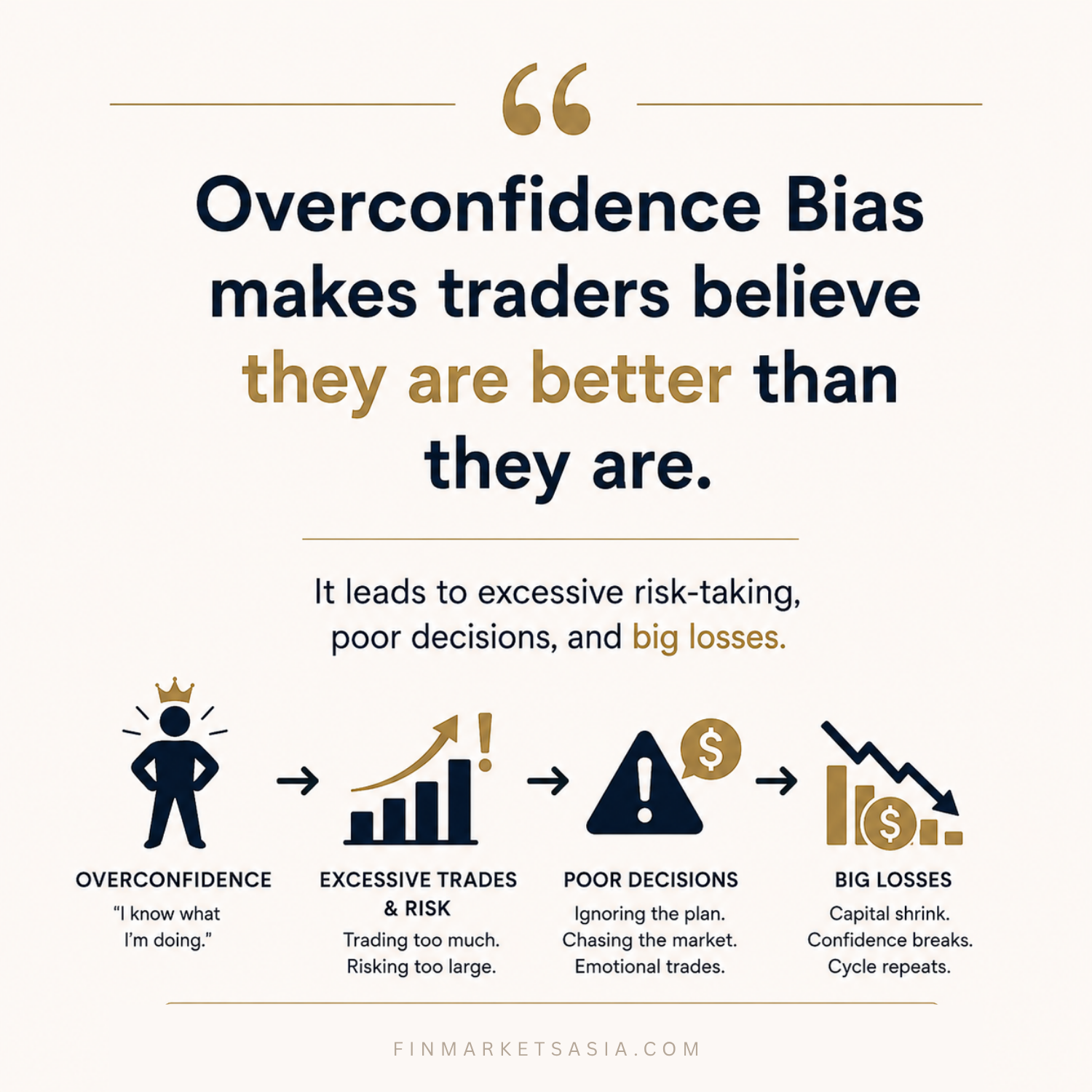
Overconfidence bias occurs when a trader’s subjective assessment of their skill, knowledge, or control over a situation significantly exceeds objective reality.In behavioral finance, overconfidence typically manifests in two ways:
1. Miscalibration (Overprecision): Believing your market forecasts are far more accurate than they actually are.
2. Illusion of Control: Believing you can influence or predict completely random or complex market outcomes.
When you experience an early win, your brain releases dopamine, reinforcing the belief that your analysis was superior. You attribute market noise to your own skill, a cognitive bias known as self-attribution bias.
The Dangerous Psychological Stages of Overconfidence
Overconfidence does not happen overnight; it develops through a predictable psychological sequence:
Stage 1: The Honeymoon Phase
You score a quick series of winning trades. You feel euphoric and start viewing trading as a fast track to wealth rather than a discipline grounded in probability and risk management.
Stage 2: Risk Creep
Because you feel invincible, you begin bending your trading rules: You increase your position sizing far beyond your standard 1–2% risk limit. You widen or remove your stop-loss orders entirely. You trade off-plan assets or volatile instruments you don't fully understand.
Stage 3: Denial and Confirmation Bias
When trades go against you, overconfidence prevents you from admitting a mistake. You search for news articles, charts, or social media posts that validate your bias while ignoring clear indicators that the market has turned against you.
Stage 4: Catastrophic Drawdown
The market forces a reality check through margin calls or forced liquidations. You suffer a devastating financial loss that erases weeks, months, or years of gains in a matter of hours.
How Overconfidence Destroys Trading Accounts
Overconfidence does not ruin traders by making them bad at technical analysis; it ruins them by causing severe risk management failure.
Behavior Driven by Overconfidence & Its Impact on Your Account
1. Over-Leveraging: Leaves your capital vulnerable to total liquidation from small, natural price fluctuations.
2. Removing Stop-Losses: Converts minor, routine losses into catastrophic, account-ending drawdowns.
3. Revenge Trading: Drives compulsive position-taking during emotional distress, rapidly compounding your losses.
4. Ignoring Macroeconomic Events: Exposes open trades to severe slippage and extreme volatility during high-impact releases (e.g., CPI, NFP).
4 Operational Strategies to Defeat Overconfidence
Losing $90,000 trading gold in 2013 was a painful turning point, but it taught me invaluable lessons about survival and discipline. To protect your capital and stay profitable long-term, you must counteract ego with strict, non-negotiable operational guardrails.
1. Separate Trading Skill from Market Luck: Never evaluate a trade solely by its monetary outcome. A flawed setup can yield a profit due to market luck, while a high-probability setup can take a loss due to random noise. Measure success strictly by rule adherence and not from short-term PnL.
2. Enforce Hard Risk Limits: Automate your risk management to eliminate emotional overrides:
-Max Risk Per Trade: Cap risk at 1% to 2% of total equity per position.
-Daily Stop-Out Limit: If daily drawdowns hit 3% to 5%, close your platform and step away from the charts immediately.
-Maintain a Performance Journal A detailed trading journal serves as an objective mirror. Track your entry/exit prices, trade rationale, risk-to-reward ratio, and psychological state throughout the trade. Weekly reviews will help you spot overconfidence and revenge trading before they damage your account.
3. Operate Like a Business, Not a Casino: Professional traders prioritize risk management above profit targets. Focus entirely on execution over payouts. Following a winning streak, resist scaling up position sizes impulsively—treat large wins with the same neutral composure as losses.
4. Respect the Market: The financial markets do not care about your past wins, financial goals, or ego; they operate purely on probability.
My $90,000 loss in 2013 was a brutal wake-up call, but it completely transformed my risk architecture. It taught me that preserving capital requires far more discipline than generating it. If you are on a winning streak, stay grounded. Keep your position sizing rational, respect your stop-losses, and remember: the market rewards consistency, but it ruthlessly penalizes overconfidence.

Rich is the founder of FinMarkets Asia, where he serves as the Chief Editor and financial markets educator. With extensive experience in the trading industry, he has worked with several leading brokerage firms as a Market Analyst, Trading Educator, and professional trader. Throughout his career, Rich has been committed to empowering traders through high-quality financial education, in-depth market analysis, and practical trading insights. His mission is to help aspiring and experienced traders develop the knowledge, discipline, and confidence needed to navigate today’s global financial markets.